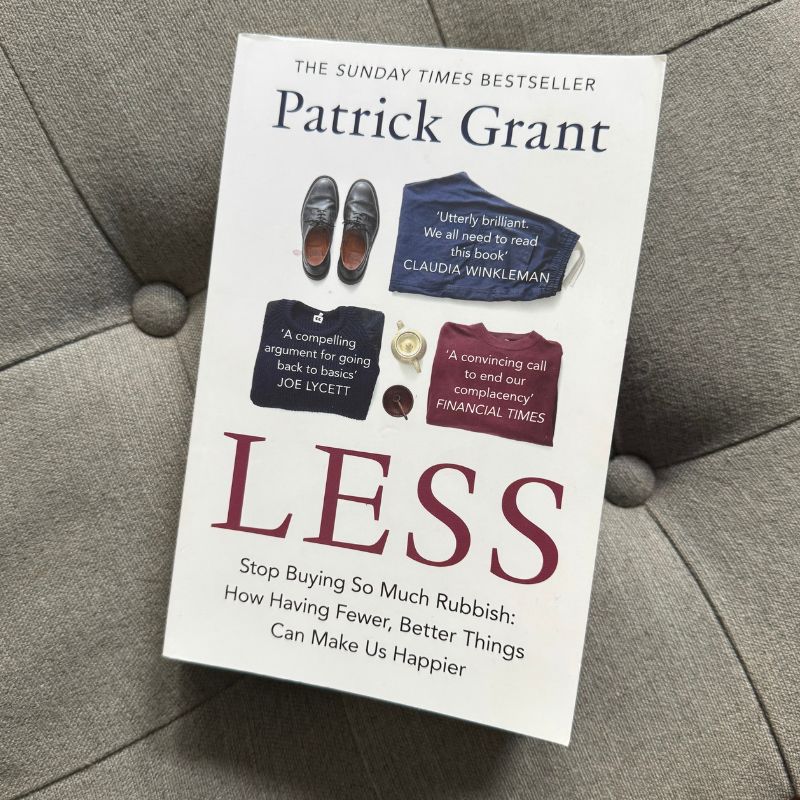
I’ve recently finished a book that put words to something I’ve felt quietly, and sometimes not so quietly, for years: a frustration that sits somewhere between sadness and anger at how disposable everything has become.
The book is Less by Patrick Grant, and it’s not simply about clothing. It’s about value, community, identity, and the quiet beauty of owning things that are made to last.
As someone who works with my hands restoring and upholstering furniture that carries its own stories, this book felt like a homecoming.
Who is Patrick Grant and why his voice matters
If you watch the BBC’s Great British Sewing Bee, you’ll already know Patrick Grant, the calm, stylish judge with an infectious passion for good design and proper making. But behind the television charm is someone who has spent decades fighting for British craft and manufacturing.
He’s the man who revived Norton & Sons, one of Savile Row’s oldest tailoring houses, and transformed it into a beacon for slow production and timeless design.
He also founded Community Clothing, a social enterprise with a powerful mission to bring life back to Britain’s textile industry by reopening factories, creating stable year-round jobs, and keeping traditional skills alive.
When you buy, say, a Community Clothing hoodie, you don’t just get a piece of clothing. You get a story. The cotton might be knitted in Leicester, dyed in Blackburn, and cut and sewn in Wigan, every stage traceable, every person fairly paid. It’s a hoodie that literally weaves community together.
That’s the kind of transparency that changes how you see your belongings.
Grant doesn’t preach about luxury; he talks about dignity, pride, and connection, the human side of making and owning things that last.
The core message of Less
Grant argues that we are drowning in cheap, poorly made goods. The UK now buys more clothing per person than any other country in Europe, yet we value our possessions less than ever.
And it’s not just clothing. The same throwaway mindset shapes how we furnish our homes.
The average modern sofa is built to last just 5 to 8 years, and every year, 22 million pieces of furniture are thrown away in the UK.
Not because the materials couldn’t last longer, but because our economy has been designed around replacement, not repair.
This costs us dearly, emotionally, financially, and environmentally.
The disappearing craft
Grant writes movingly about the slow death of skilled trades.
Today, fewer than 1 in 10 young people are encouraged into craft or hands-on careers.
That’s not just a loss of job opportunities. It’s a loss of identity and continuity, of the knowledge that once defined communities.
When we choose to buy something made or restored locally, we’re not just buying an object. We’re keeping a skill alive, feeding a local economy, and sustaining pride in workmanship.
A short history of making
One of the most compelling parts of Less looks back at the evolution of production itself. Grant reminds us that the original spirit of manufacturing was about improving processes, making things better, more beautiful, and more efficient through ingenuity and care.
Craftsmen and early industrialists alike were driven by curiosity and pride in progress. They asked, “How can we make this better?”
Today, that question has been replaced by another: “How can we make this cheaper?”
It’s a subtle shift with enormous consequences for quality, for people, and for the planet. Instead of driving innovation, cost-cutting drives compromise.
Fast Furniture: Fast Fashion in Disguise
Think of fast furniture in the same way you’d think of a £3 T-shirt.
Made quickly
From weaker materials
Designed to be replaced soon
Mass-produced to chase trends rather than meet needs
It may feel cheap, but it’s costing us more than we realise.
Every time we buy something manufactured overseas, a lot of the money we spend leaves our local economy, flowing through global supply chains rather than the communities we live in.
As Grant points out, for every £1 spent with Community Clothing, 90 pence stays in the UK economy, with around half of it going directly on wages. Then he asks, “Would you rather your money go to Jeff Bezos, or your bezzy Jeff?”
That one line captures the whole spirit of Less: the idea that what and where we buy truly matters.
Why bespoke or restored furniture is ‘Less, but better’
When you work with a craftsperson, you become part of the process.
You choose the fabric.
You feel the textures.
You share stories.
That connection changes everything. You don’t throw away stories.
A handmade or restored piece might cost more upfront, but it pays you back in years of use, satisfaction, and meaning. Just like a well-cut suit, it fits your life perfectly, and it only gets better with time.
A chair that tells a story
One of my favourite ever projects was a Parker Knoll armchair I rescued for free on Facebook Marketplace. The solid beech frame was structurally sound, though the upholstery was worn and the legs badly scuffed. I stripped it back to the frame and reupholstered it using ‘Rita Does Jazz’, a bold, design-led velvet from The Monkey Puzzle Tree, based in Leeds. .
What makes this fabric special is how deeply local and craft-driven the production is. The Monkey Puzzle Tree commissions Yorkshire artists and gives them 20% royalties on their designs, so creators continue to earn from their work. They also use traditional techniques like screen printing and rotary printing in their manufacturing, preserving skills often overlooked in modern textile production.
That means the fabric you see on the chair was not only designed by a British artist but printed using time-honoured methods nearby. In giving this chair a second life, I’m not just restoring furniture, I’m weaving together decades of British craftsmanship, supporting local artists, and reconnecting the past to the present.
A chair originally made in 1983 now lives again, carrying with it stories of skilled hands, thoughtful design, and the possibility of simpler, slower, better living.
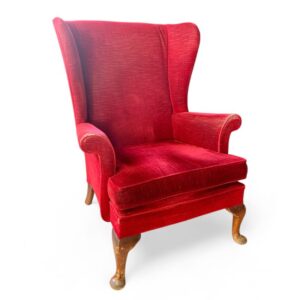
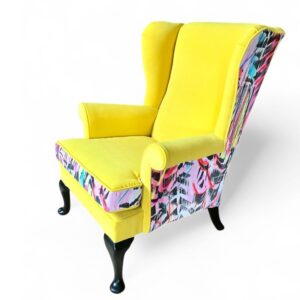
Before and After: A Chair Worth Saving
This chair is proof that good design and craftsmanship never really go out of date , they just need a little time and care to shine again.
Hard truths and a hopeful message
Patrick Grant doesn’t shy away from hard facts. He writes that the global fashion industry produces 100 billion garments a year, of which, 30% of those are never even sold and there are enough clothes on the planet to provide for the next six generations…mind blowing huh?
But Less is ultimately a hopeful book. It reminds us that change doesn’t come from guilt, but from better choices. It begins with caring about people, about skill, about the things we bring into our homes.
A final thought
Next time you’re about to buy something new, ask yourself:
Can I buy this from a person, not a corporation?
Can I choose something made to last, not to be replaced?
If the answer might be yes, I’d love to help.
Let’s create something meaningful and lasting together.
And as for Less – I give it the full five stars, wholeheartedly.
It’s a book that will make you look at everything you own, and everything you buy next, with new eyes.
About the book
Less: Stop Buying So Much Rubbish – How Having Fewer, Better Things Can Make Us Happier
By Patrick Grant
Published by HarperCollins
Patrick Grant is a designer, TV personality, and champion of British manufacturing. He is best known as a judge on The Great British Sewing Bee and as the founder of Community Clothing, a social enterprise supporting UK textile workers and factories.
You can buy Less directly from independent retailers here:
Bookshop.org (UK) – supports local independent bookshops
Waterstones – for UK delivery and in-store pickup
Or visit your local independent bookshop – because buying local matters, just like the message of the book itself.